21
Understanding SEO Meta Tags: Why They Matter and How to Check Yours
Learn what SEO meta tags are, why they are essential for your website's visibility, and how you can optimize and check them effectively.
Introduction to SEO Meta Tags and Their Role in Digital Marketing
When you invest time and resources into building a website, creating high-quality, engaging content is only half of the digital battle. The other crucial half is ensuring that search engines, and consequently your target audience, can actually find, parse, and understand that content. This is precisely where SEO meta tags come into play. Meta tags are essentially microscopic snippets of text that describe a web page's content. Unlike the visible text you read on a blog post or landing page, meta tags don't appear on the page itself; rather, they exist hidden within the page's underlying HTML source code. In this comprehensive and detailed guide, we will explore why meta tags are absolutely critical for your website's overall success, delve into the different types of meta tags you need to care about, and explain exactly how you can manage, write, and check them efficiently to maximize your online visibility.
What Are Meta Tags and Why Do They Fundamentally Matter?
To put it simply, search engines like Google, Bing, and Yahoo use the metadata provided by your meta tags to understand exactly what a specific webpage is about. This foundational information helps their complex algorithms index your pages accurately within their massive databases and, more importantly, display highly relevant snippets in the search engine results pages (SERPs) when a user types in a query. If your meta tags are poorly written, irrelevant, or entirely missing, you run a significant risk of losing out on thousands of potential visitors. This happens because your pages might not rank well for your target keywords, or even if they do rank, they might appear unappealing and vague in the search results, failing to attract clicks.
Well-crafted meta tags serve an incredibly important dual purpose in the world of Search Engine Optimization. First, they explicitly communicate your page's specific relevance to the opaque algorithms of search engines. Second, and equally important, they act as a compelling, bite-sized advertisement designed to entice human users to click on your link rather than a competitor's. You can think of your meta tags as the digital storefront window to your content—they need to be inviting, accurate, and optimized for both robots and human readers.
The Most Important Types of Meta Tags You Should Be Using
1. The Title Tag (The Heavyweight Champion)
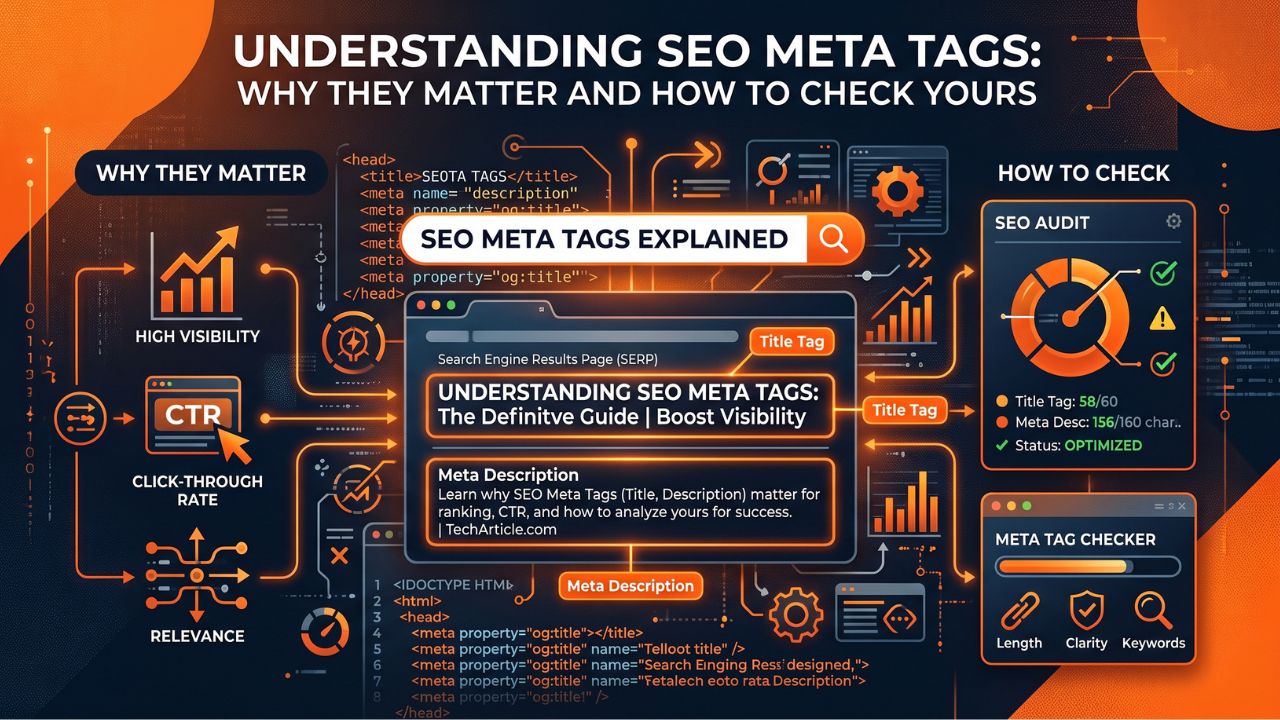
The title tag is almost universally considered the most crucial meta tag for on-page SEO. It explicitly specifies the title of a web page and is displayed prominently on SERPs as the large, blue, clickable headline for a given search result. Additionally, it's the title shown in the user's web browser tab, helping them navigate multiple open pages. Because of its prominence, optimizing the title tag should be your first priority.
- Optimal Length: You should always aim to keep your title tag under 60 characters. If it exceeds this limit, search engines will likely truncate it with an ellipsis (...), which can cut off important words and make the title look messy.
- Keyword Placement: Include your primary target keyword, ideally placing it as near to the beginning of the title as naturally possible. Search engines give slightly more weight to words appearing early in the title tag.
- Brand Awareness: If space permits, it is a great practice to append your brand or company name at the very end of the title tag (e.g., "Your Primary Keyword | YourBrand Name"). This builds brand recognition over time.
2. The Meta Description (The Sales Pitch)
The meta description is an HTML attribute that provides a brief, concise summary of a web page's content. Search engines often display this description in the SERPs directly underneath the blue clickable title tag. While Google has stated that the meta description is not a direct ranking factor in their algorithm, a well-written, persuasive meta description significantly influences your organic click-through rate (CTR). A higher CTR can indirectly signal to Google that your page is relevant and valuable, potentially boosting your rankings over time.
- Optimal Length: Aim for a sweet spot of between 150 and 160 characters. Anything longer runs the risk of being truncated on desktop and mobile displays.
- Action-Oriented Language: Use active voice and include a clear, compelling call-to-action (CTA). Phrases like "Learn more," "Discover how," or "Get your free guide" can encourage users to take the next step.
- Absolute Relevance: Ensure the description accurately and honestly reflects the actual content on the page. If a user clicks based on a deceptive description, they will immediately "bounce" back to the search results, which is a strong negative signal to search engines.
3. The Robots Meta Tag (The Traffic Director)
This specific tag gives search engine crawlers (like Googlebot) specific, granular instructions on exactly how to handle the page they are currently reading. You can explicitly tell them whether to index the page and display it in search results (index) or to ignore it completely (noindex). Furthermore, you can instruct them whether to follow the outbound and internal links located on the page (follow) or not (nofollow). This tag is vital for controlling how your site is crawled, managing your crawl budget, and keeping private or duplicate pages out of the public search index.
4. The Viewport Meta Tag (The Mobile Optimizer)
In today's predominantly mobile-first digital environment, implementing the viewport meta tag is absolutely non-negotiable. It explicitly instructs the user's mobile browser on how to adjust the page's dimensions and scaling to perfectly fit the screen width of the specific device being used. Without this tag, your beautiful website might look like a miniature, unreadable mess on a smartphone, leading to an incredibly frustrating user experience and almost guaranteed poor mobile search rankings.
How to Write Highly Effective Meta Tags
Writing truly effective meta tags requires a delicate and strategic balance between technical keyword optimization and human-centric psychological appeal. You should always start your process by conducting thorough keyword research to uncover the exact terms and phrases your target audience actually types into search engines. Once you have identified your primary and secondary keywords, you must integrate them naturally and organically into your title and description.
You must rigorously avoid the outdated tactic of "keyword stuffing"—the frowned-upon practice of cramming as many keywords as humanly possible into your tags in a desperate bid to rank higher. This not only looks terribly unnatural and spammy to human users, but it can also actively harm your rankings, as modern search algorithms easily penalize such manipulative behavior. Focus instead on providing a clear, concise, and incredibly compelling summary of the specific value your page offers the reader.
If you are unsure exactly where to start, if you are struggling with character limits, or if you simply want to dramatically streamline your entire optimization process, you should strongly consider using a dedicated SEO Tags Generator. These intuitive tools can intelligently help you craft perfectly structured, engaging, and appropriately lengthed meta tags for literally any page on your website, saving you hours of frustrating trial and error.
How to Check, Analyze, and Audit Your Meta Tags
It is a common misconception that once you have initially implemented your meta tags, your SEO work is magically finished. In reality, it is absolutely essential to regularly audit and monitor them to ensure they are actually performing well, driving clicks, and haven't been inadvertently deleted or broken by recent content management system (CMS) updates or site redesigns. You can technically check your meta tags manually by right-clicking on your webpage, selecting "View Page Source" (or "Inspect"), and manually scanning through the dense HTML code to find the <meta> and <title> tags nestled within the <head> section.
However, relying on this manual process for every single page on a growing or large-scale website is incredibly tedious, time-consuming, and highly prone to human error. A significantly better, more professional approach is to utilize an automated and powerful SEO Analyzer. A robust SEO analyzer will automatically crawl your entire website, quickly highlighting any missing, overly long, or duplicate tags. It will identify systemic issues and provide clear, actionable feedback and prioritized recommendations on how to dramatically improve your overall on-page SEO strategy, saving you immense amounts of time and ensuring your site remains fully optimized.
Common Meta Tag Mistakes You Must Avoid
- Using Duplicate Tags: Having completely identical title tags or meta descriptions across multiple different pages confuses search engine crawlers. It forces your own pages to compete against each other in the search results and dilutes your SEO authority. Every single indexed page must have unique tags.
- Writing Irrelevant Descriptions: If your meta description aggressively promises one specific thing but the actual page content delivers something entirely different, users will feel tricked. They will immediately "bounce" back to the search results, drastically increasing your bounce rate and signaling a very poor user experience to search engines.
- Ignoring Imposed Character Limits: Truncated titles and descriptions that end in ellipses look unprofessional, unfinished, and can completely obscure your main message or call to action, plummeting your click-through rates.
- Forgetting the Tags Entirely: Failing to include title tags or meta descriptions means you are letting the search engine randomly decide what snippet to show users, which is almost always a suboptimal, disjointed extraction of text from your page.
Conclusion: Take Control of Your SEO
SEO meta tags are a foundational, undeniable element of successful on-page optimization. By taking the dedicated time to fully understand their fundamental purpose, writing compelling and strategically optimized titles and descriptions, and regularly auditing your entire site's technical health with the right professional tools, you can significantly improve your search engine visibility. This, in turn, will drive a much higher volume of qualified, targeted organic traffic directly to your website. Do not leave your valuable click-through rates to pure chance or automated guessing—take proactive control of your meta tags today and watch your online presence grow.
Contact
Missing something?
Feel free to request missing tools or give some feedback using our contact form.
Contact Us