22
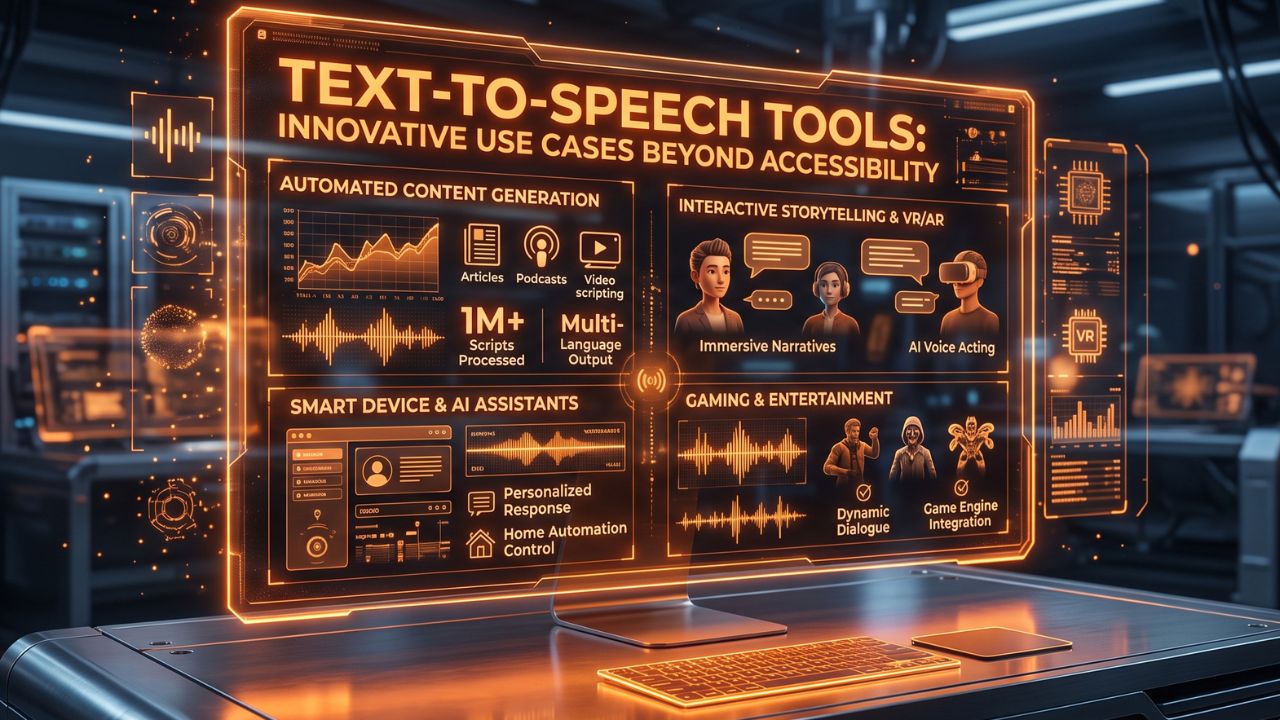
Text-to-Speech Tools: Innovative Use Cases Beyond Accessibility
Explore how modern Text-to-Speech (TTS) tools are revolutionizing content creation, learning, productivity, and entertainment far beyond their traditional accessibility roles.
The Evolution of Text-to-Speech Technology
For decades, Text-to-Speech (TTS) technology has been synonymous with accessibility. It was originally developed to assist individuals with visual impairments or reading disabilities, providing a vital bridge to written information. While this remains a crucial and noble application, the landscape of TTS has expanded dramatically. Thanks to rapid advancements in artificial intelligence and machine learning, today's TTS voices no longer sound like robotic, stilted automatons. They are highly realistic, expressive, and capable of capturing subtle human nuances like pacing, intonation, and emotion.
This leap in quality has unlocked a plethora of innovative applications. Text-to-speech tools are now being leveraged by professionals, creators, students, and everyday users to enhance productivity, create engaging content, and transform how we consume information. In this article, we will explore the exciting and diverse use cases for TTS that go far beyond traditional accessibility.
Revolutionizing Content Creation
Content creators are constantly looking for ways to reach broader audiences and repurpose their work across multiple platforms. TTS tools have become an invaluable asset in this endeavor.
1. Turning Blog Posts into Podcasts
In the fast-paced digital age, many consumers prefer listening over reading. A long commute or a workout session is the perfect time for an audio experience, but not everyone has the time or equipment to record a professional podcast. By using a high-quality Text to Speech Tool, bloggers and publishers can instantly convert their written articles into engaging audio formats. This allows them to tap into the booming podcast market with minimal extra effort, giving their audience the flexibility to consume content on the go.
2. Voiceovers for Videos and Animations
Creating compelling videos often requires professional voiceovers, which can be expensive and time-consuming to produce. Hiring voice actors involves casting, scheduling recording sessions, and multiple revisions. TTS software offers a cost-effective and immediate alternative. YouTube creators, marketers, and animators can generate high-quality voiceovers in seconds, easily adjusting the script and generating new audio on the fly. With modern tools offering a variety of accents, genders, and tones, creators can find the perfect voice to match their brand identity.
3. Audiobook Production
The demand for audiobooks has skyrocketed, but the traditional production process is historically prohibitive for independent authors. AI-driven text-to-speech is changing the game by allowing authors to generate audiobooks directly from their manuscripts. While traditional narration by a human actor still holds premium value, TTS provides a highly accessible entry point for self-published authors to offer their work in audio format, significantly expanding their potential readership.
Enhancing Learning and Education
The educational sector is another area where TTS is making a profound impact, offering new ways to engage with material and improve retention.
1. Language Learning and Pronunciation
Learning a new language is challenging, especially when it comes to mastering pronunciation and cadence. TTS tools are incredibly beneficial for language learners. By inputting text in a target language, students can hear exactly how a native speaker would pronounce specific words or phrases. Many platforms allow users to adjust the reading speed, enabling beginners to slow down complex sentences and gradually increase the pace as their comprehension improves.
2. Auditory Learning and Study Aids
Everyone has a different learning style. While some students absorb information best by reading, auditory learners benefit from hearing the material. Students can use TTS to listen to their digital textbooks, study notes, or research papers. Listening to their own essays read aloud is also a powerful proofreading technique, helping to identify awkward phrasing or grammatical errors that the eye might easily skip over on a screen.
Boosting Workplace Productivity
In the corporate world, time is money, and efficiency is paramount. TTS technology is seamlessly integrating into workflows to help professionals manage their time more effectively.
1. Multitasking and Commuting
Professionals often struggle to keep up with industry news, reports, and lengthy emails. TTS allows them to transform reading time into listening time. By having emails or reports read aloud, professionals can absorb important information while commuting, exercising, or performing routine administrative tasks. This dual-tasking approach reclaims lost hours and significantly boosts overall productivity.
2. Reviewing Documents and Proofreading
Just as students use TTS to proofread essays, professionals can use it to review important documents, proposals, and contracts. When you have been staring at the same document for hours, your brain starts to auto-correct errors, making it difficult to spot mistakes. Hearing the document read aloud forces a different cognitive engagement, making it much easier to catch typos, repetitive phrasing, and structural issues.
Entertainment and Gaming Integrations
The entertainment industry, particularly gaming, is leveraging TTS to create more immersive and dynamic experiences.
1. Dynamic NPC Dialogue
In massive open-world role-playing games, developers traditionally have to record thousands of lines of dialogue for non-playable characters (NPCs). This requires immense storage space and limits the flexibility of the dialogue. By integrating advanced TTS engines directly into the game, developers can generate dynamic, on-the-fly dialogue. This means NPCs can react to player choices with uniquely generated speech, creating a richer, more personalized gaming experience without ballooning the game's file size.
2. Interactive Storytelling and Mods
The modding community relies heavily on TTS to add new quests and stories to existing games. Without the budget to hire voice actors, modders use these tools to give their custom characters a voice, bringing their creative visions to life and sharing them with the wider gaming community.
The Future of Text-to-Speech
As artificial intelligence continues to advance, the capabilities of text-to-speech tools will only become more impressive. We can expect even greater emotional intelligence in synthetic voices, the ability to mimic specific individuals with uncanny accuracy (which brings its own set of ethical considerations), and seamless real-time translation and vocalization.
While accessibility will always remain a foundational pillar of TTS technology, its applications have decisively broadened. From empowering independent creators and aiding auditory learners to streamlining corporate workflows and enhancing digital entertainment, Text-to-Speech has evolved into a versatile, powerful tool that is fundamentally changing how we interact with the written word.
Contact
Missing something?
Feel free to request missing tools or give some feedback using our contact form.
Contact Us