21
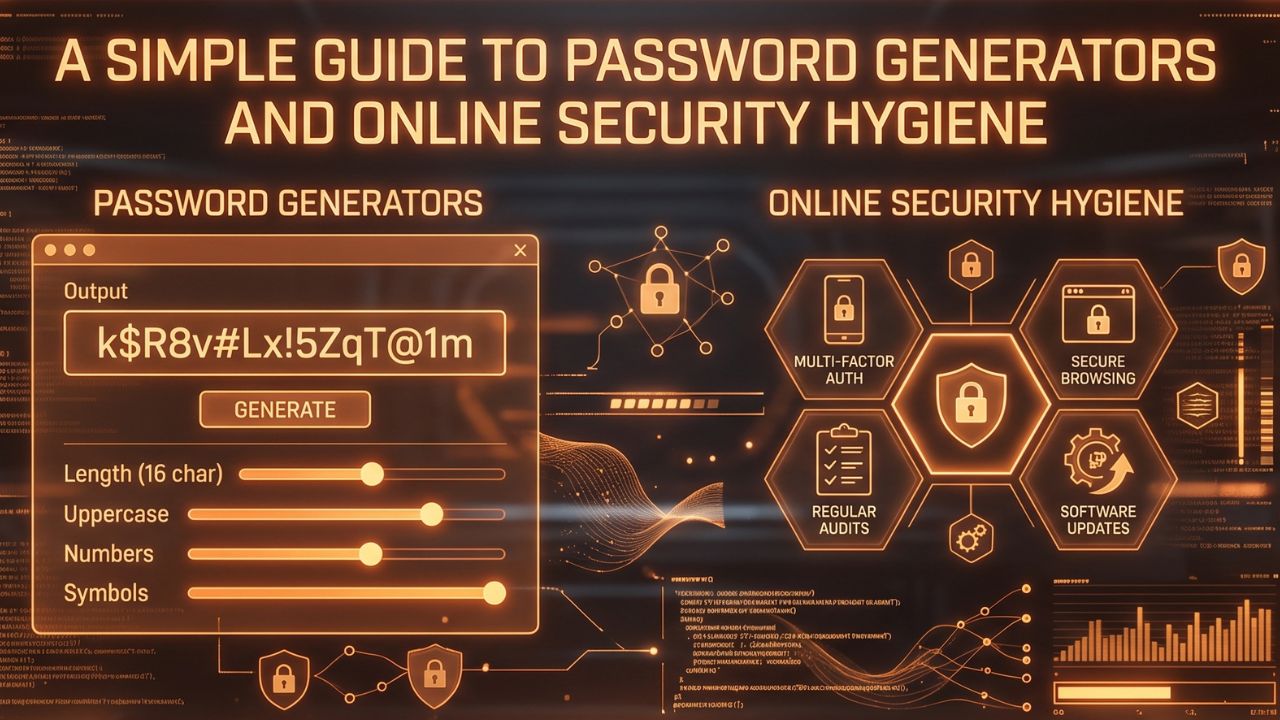
A Simple Guide to Password Generators and Online Security Hygiene
Learn the importance of online security hygiene, why weak passwords are a major risk, and how password generators can dramatically improve your digital safety.
The Growing Importance of Online Security Hygiene
In our increasingly digitized world, almost every aspect of our personal and professional lives is tethered to the internet. From our primary bank accounts and confidential medical records to our private social media profiles and essential professional emails, our most sensitive and critical information is stored online behind digital locked doors. The keys to these incredibly important doors? Our passwords. Unfortunately, despite constant warnings from cybersecurity experts, the vast majority of internet users still practice shockingly poor online security hygiene. This widespread negligence leaves individuals highly vulnerable to devastating identity theft, severe financial fraud, and catastrophic personal data breaches.
Online security hygiene refers to the daily habits and routine practices that users employ to ensure the absolute safety and integrity of their digital lives. Just as you would lock the front door of your physical house or consistently brush your teeth to maintain physical health, practicing good digital hygiene is a non-negotiable requirement for modern living. In this comprehensive guide, we will deeply explore the most common pitfalls of modern password creation, thoroughly explain exactly why you should immediately adopt the use of password generators, and provide you with actionable, straightforward steps to drastically fortify your personal cybersecurity posture.
The Fatal Flaws of Human-Created Passwords
The core of most personal cybersecurity failures lies in human psychology. When forced to create a new password for a website, the average human brain naturally gravitates toward convenience and memorability rather than genuine mathematical security. We inherently want something we can easily recall without having to write it down. This completely understandable human trait leads directly to several massive security vulnerabilities:
1. Predictability and Dictionary Attacks
Humans are incredibly predictable creatures. We overwhelmingly tend to use common dictionary words, well-known pop culture references, our children's names, beloved pet names, or easily discoverable significant dates (like birthdays or anniversaries) in our passwords. Cybercriminals are well aware of this tendency. They employ highly automated software programs that can rapidly execute "dictionary attacks." These sophisticated programs can automatically test millions of common words and easily predictable combinations in mere seconds. If your password is "ilovedogs123" or "password2024," a basic automated script will crack it almost instantly.
2. The Danger of Password Reuse
Perhaps the single most dangerous and prevalent habit in digital security is password reuse. Because memorizing dozens of unique, complex passwords is functionally impossible for most people, the average user relies on a tiny rotation of two or three passwords across dozens or even hundreds of different websites and applications. The catastrophic danger here is obvious: if just one of those websites suffers a database breach (which happens with alarming frequency), hackers immediately gain access to that reused password. They then use automated bots in a process called "credential stuffing" to rapidly test that same email and password combination across thousands of other sites—including major banks, email providers, and retail stores—instantly compromising your entire digital identity.
3. The Illusion of Complexity
Even when users try to follow the standard rules by adding a number or a special character, they usually do so in incredibly predictable ways. Capitalizing the first letter and adding a "1!" to the end of a word (e.g., "Monkey1!") does not create a strong password. Hackers' algorithms have been specifically programmed for years to anticipate exactly these types of standard, human-created variations.
The Essential Solution: Password Generators
To fundamentally solve the problem of human predictability and the dangers of password reuse, you must completely remove the human element from the actual creation process. This is exactly where automated password generators become essential tools.
A high-quality password generator is a software tool designed to instantly create incredibly complex, entirely random strings of characters that are statistically impossible for humans to guess and mathematically incredibly difficult for computers to crack via brute-force attacks. When you utilize a secure password generator, you can easily define specific parameters—such as the exact length of the password (always aim for 16 characters or more), and whether to explicitly include uppercase letters, lowercase letters, numbers, and a wide array of special symbols.
The resulting password might look something like j%8^Kd#9Lq2@zX5v. While absolutely impossible to memorize, this truly random password offers a level of cryptographic security that completely dwarfs any human-created phrase.
How to Safely Manage Generated Passwords
The immediate and obvious question arises: "If I use a generator to create 50 different, completely unmemorizable passwords, how on earth am I supposed to log into anything?" The answer is simple, secure, and widely recommended by all cybersecurity professionals: you must use a dedicated Password Manager.
A password manager is an encrypted, highly secure digital vault that automatically stores all of your complex generated passwords. You only need to memorize one single, incredibly strong "Master Password" to unlock the entire vault. The password manager will then seamlessly autofill your highly complex, unique passwords whenever you visit a website or launch an app. By combining a password generator with a reputable password manager, you effortlessly achieve the gold standard of digital security: every single account you own has a completely unique, highly complex password, and you never have to remember any of them.
Testing Your Current Security Posture
If you are still unconvinced about the urgent need to upgrade your security habits, or if you simply want to evaluate the strength of the passwords you are currently relying on, you should test them. You can easily use an automated password strength test to instantly analyze your current credentials. These sophisticated tools evaluate your password based on its length, character variety, and resistance to common brute-force algorithms. They will clearly calculate an estimated "time to crack," providing a stark, eye-opening realization of just how vulnerable your current favorite password might actually be against modern computing power.
Core Principles of Ongoing Digital Hygiene
Beyond simply using strong passwords, maintaining excellent online security hygiene requires a holistic approach and a few ongoing practices:
- Enable Multi-Factor Authentication (MFA): Whenever a service offers it, you must turn on MFA (also known as 2FA). This critical security layer requires you to provide a second form of verification (like a temporary code sent via an authenticator app or SMS) in addition to your password. Even if a highly skilled hacker manages to steal your password, they absolutely cannot access your account without that secondary, temporary code.
- Stay Vigilant Against Phishing: Phishing scams remain incredibly prevalent and effective. Cybercriminals will send highly convincing, fake emails or text messages desperately trying to trick you into clicking malicious links or voluntarily handing over your login credentials. Always verify the actual sender's email address and never click suspicious links.
- Keep Software Updated: Regularly updating your operating system, web browsers, and all applications is crucial. Software updates frequently contain critical security patches that specifically fix newly discovered vulnerabilities that hackers actively exploit.
Conclusion: Prioritize Your Digital Safety
In an era where data breaches make daily headlines and cyber threats are constantly evolving, relying on a few easily memorable passwords is no longer just risky; it is fundamentally irresponsible. By recognizing the inherent flaws in human-created passwords and actively embracing modern tools like password generators and encrypted managers, you can instantly and dramatically enhance your online security hygiene. Take proactive control of your digital life today—generate stronger passwords, enable multi-factor authentication, and build an impenetrable digital fortress around your most sensitive and valuable information.
Contact
Missing something?
Feel free to request missing tools or give some feedback using our contact form.
Contact Us